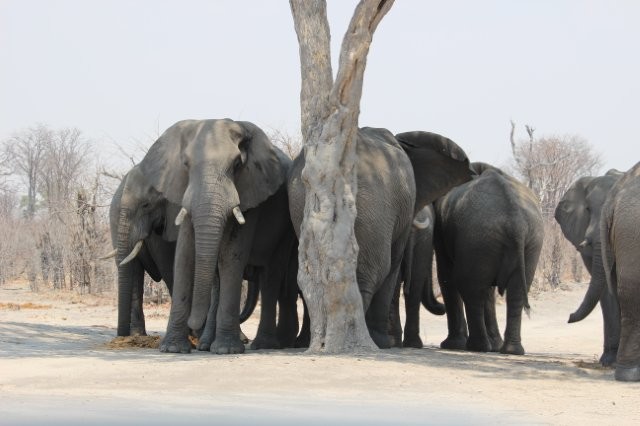
‘Intelligences’
In their innocence and wisdom, in their connection to the earth and its most ancient rhythms, birds and animals show us a way back to a home they have never left.
Susan Chernak McElroy[11]—Animist
Robin Wall Kimmerer [12], a Potawatomi [13] person, speaks to the heart about the ‘intelligences’ of the natural world around us:
Imagine walking through a richly inhabited world of Birch people, Bear people, Rock people, beings we think of and therefore speak of as persons worthy of our respect, of inclusion in a peopled world.
We…are reluctant to learn a foreign language of our own species, let alone another species. But imagine the possibilities. Imagine the access we would have to different perspectives, the things we might see through other eyes, the wisdom that surrounds us. We don’t have to figure everything out by ourselves: there are ‘intelligences [14]’ other than our own, teachers all around us.
Robin Wall Kimmerer inspired us to change the way we address our animate friends:
The Green family visited the Cederberg Mountains to explore the ‘intelligences’ of animals and the South African San indigenous people, and their connections with each other.
These are the Photo Ahimsa experiences they share:
The Cederberg is a gigantic rock wilderness where wind and rain have hollowed colossal sandstone rocks into weird rust-red, brown, yellow, orange, and white shapes in every shade.
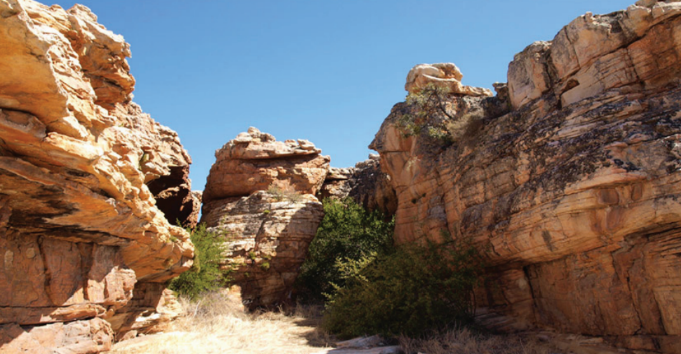 Figure 5: Rock Formations—Cederberg |
We hiked the enchanting, well-preserved natural art gallery, the Sevilla Rock Art Gallery—a 6 km trek and climb that started at a restaurant entrance and led up into the surrounding hills.
As we set off on our trek and climb, we received a cheerful little reminder—“Watch out for snakes!” Perfect, just what we needed as we were trying to forget the idea of slithering surprises. Then we saw a procession of restaurant staff emerge from the restaurant, with someone pushing a wheelie bin. We heard cries of ‘Snake—puff adder!’
This curious snake had probably gobbled up a rat in the pantry and was sleeping it off in the corner. We don’t know how the snake got into a wheelie bin—maybe someone coaxed it in. The people still enjoying breakfast in the restaurant filed out after the procession of restaurant staff. We did too. Everyone was armed with a mobile phone, a tablet or a camera—ready to take ‘selfies’ with a snake.
It was like following the ‘Pied Piper of Hamelin’.
The crowd took position a few metres away from the side of the tarred road next to the restaurant entrance gate. Most of us took selfies with the puff adder, which eyed us rather suspiciously.
Peter took one of the best.
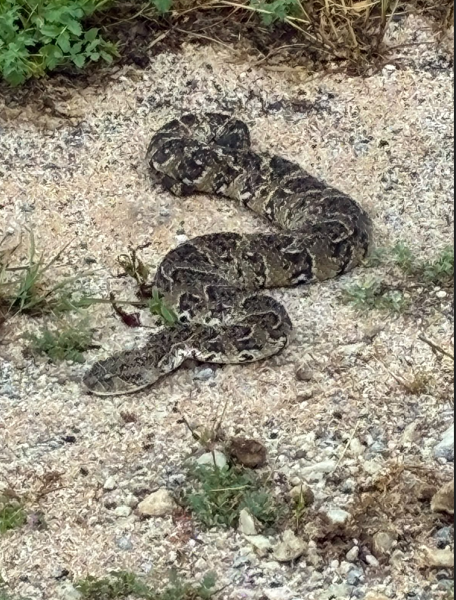 Figure 6: Peter’s Puff Adder—Sevilla Rock Art Trail |
After the puff adder episode, we entered an enchanting natural art gallery, the Sevilla Rock Art Gallery, and took many photographs of the rock art. Jim read up about the rock art after the trip to the Cederberg, regarding the works of art they encountered and photographed as they clambered over rocks, entered rocky overhangs, and slid into shallow caves [17].
These are Jim’s comments and observations:
Style of Rock Art
The Cederberg is home to a great variety of San rock art. San rock art is an ancient, spirit-connected cultural tradition, with a distinct artistic style.
Why is the rock art so special?
San painters understood the challenges and opportunities of their rock ‘canvases’: they understood the difficulties of an uneven, coarse surface, and they had total control over how they applied their paint. The paint flowed easily without blotting or drying, and the tools they used held it well and let it flow evenly. The result—enduring rock art, a true legacy!
Their art features earthy colours made from natural pigments. It includes shades like ochre, black charcoal, and warm reds, oranges, and yellows. These colours come from weathered iron oxides found in the Cederberg area, while the rare black pigment is made from oxides or charcoal.
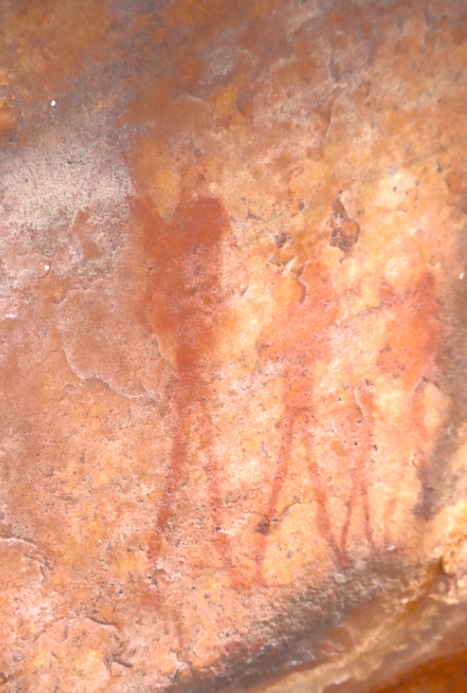 Figure 7: Weathered Iron Oxide Colours |
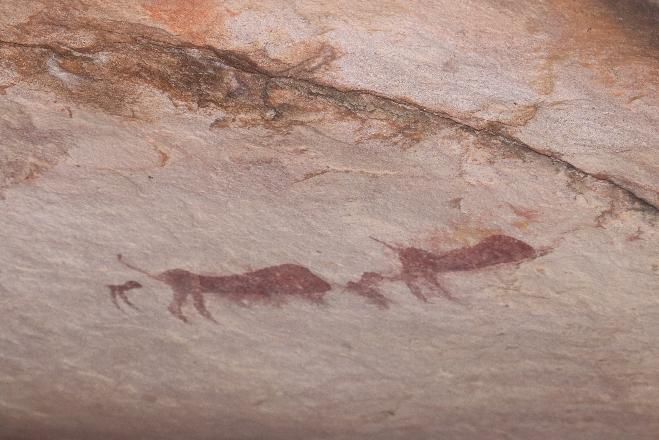 Figure 8: Black is Rare |
The artists ground the pigments on flat stones into a very fine powder, since coarse grains would not penetrate the rock’s surface well enough to remain as a painted image.
Many of the paintings are monochromes—one colour, most often some shade of ochreous red. Some are biochromes, where different parts of the image are different colours.
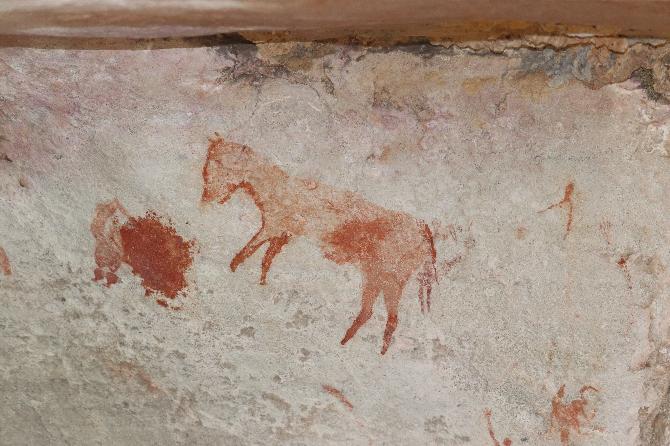 Figure 9: Biochromes |
Tools
Much less is known about the tools the San used. Animal-hair brushes? Tips of porcupine quills? Chewed and softened ends of small sticks? Bird feathers?
In the pre-colonial San art, paint and style are sophisticated, while colonial-era art is crude, single-colour, and made with a finger—as different as night and day from the elegant, fine-line tradition that created big animals and dancing figures.
The Dancers
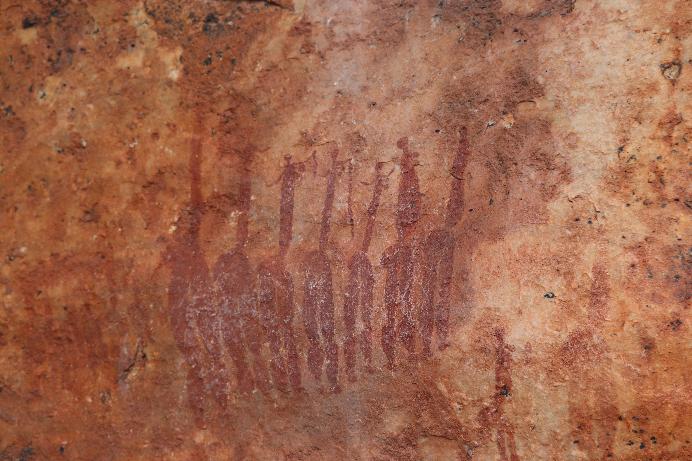 Figure 10: The Dancers |
Anthropologists and Art Historians tell us that these art forms are not only decorative; they soar into a spiritual realm, telling stories of creation, ancestors, and sacred beings through dancers.
As we gazed at these works of art, we became aware that the San were integrally connected to their ecosystem and that everything had life, meaning and spirit: the rain and wind, the clouds and sun, the rocks and animals—just like the Potawatomi!
As we hiked up and down rocky paths and into cool, protected overhangs while taking photographs, human figures, domestic and wild animals, plants, and insects all appeared in unfolding graphic stories.
Some animals appeared more often and took centre stage—animals such as the eland, giraffes, rhinos and elephants. Birds such as the kori bustard and ostriches, and insects such as the praying mantis, were represented, but unfortunately, we could not find any of those.
We learned that San art is a ‘thin place’—a window into their spiritual universe!
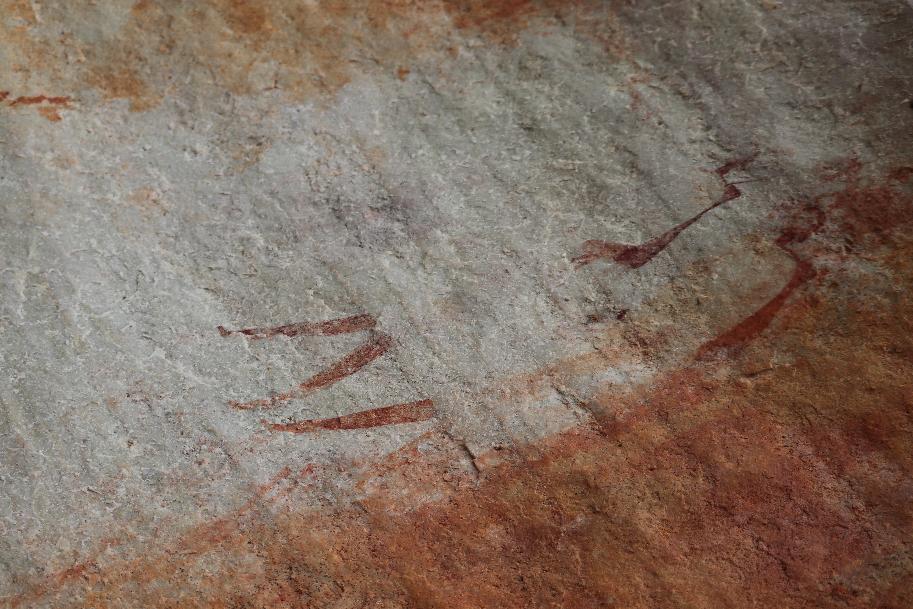 Figure 11: San Spiritual Art and Culture |
The Interlopers
We had learned in our history and ‘race studies’ subjects at school that the San [‘those without cattle’], or Bushmen [derogatory], were the hunter-gatherers our ancestors had encountered when they first arrived at the Cape of Good Hope in the 17th Century.
We were taught that before our forebears arrived, thousands of generations of San had lived, hunted, and gathered (and painted on rocks) as the sole inhabitants of the Cape area. We knew that tiny clans—remnants of these once-numerous indigenous people—still exist in some areas, such as the Kalahari Desert.
We knew about the conflicts that the San had with European colonists over land. Our forebears were people of those times—they believed they were entitled to take the land from the little people who were closer to the primates than to themselves.
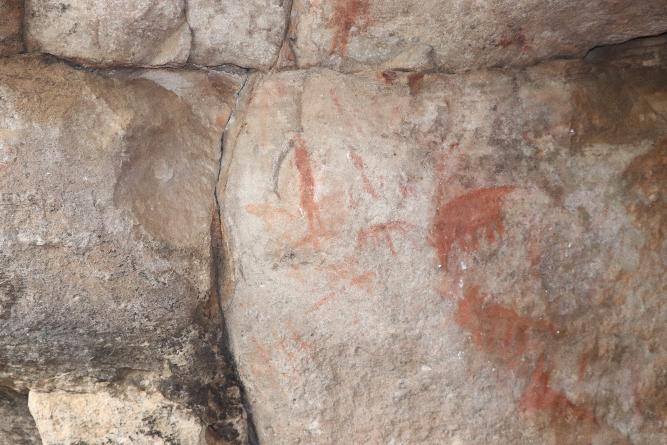 Figure 12: Cattle—The Bane of the San |
The rock art we saw reflected the changes in the fortunes of the San, from precolonial times through to the times when colonising farmers engulfed San groups, turning their hunting areas into farmland and grazing their cattle where wildlife once roamed.
This confirmed what we had learned in our South African history lessons in the Apartheid era, that the San were quickly absorbed into colonial society as domestic servants or farm labourers. Only in recent times were we to learn that huge numbers were exterminated in systematic campaigns to rid the land of ‘Bushmen’—a genocide by modern standards!
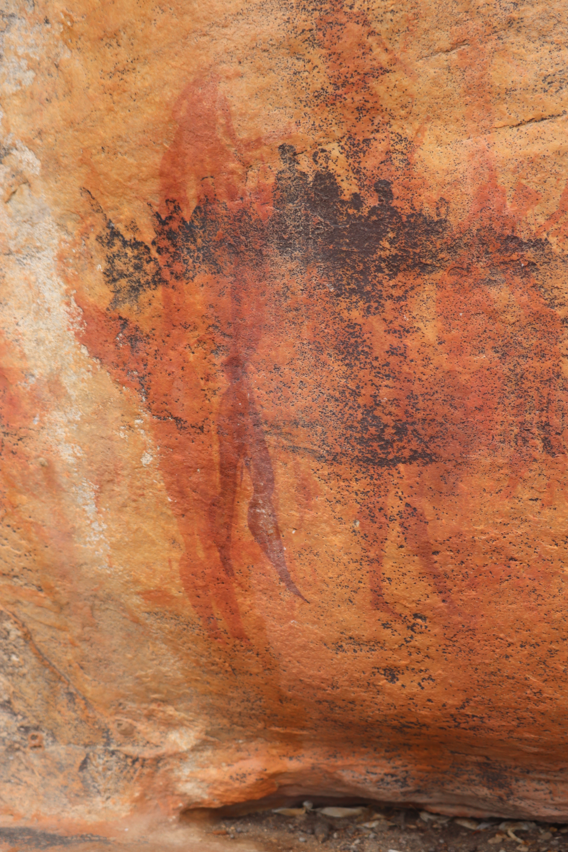 1Figure 13: The Colonial Menace? |
The Dancers, Shamans and the Trickster
In many paintings, we noticed that they wore (and still do in the Kalahari) dance rattles on their ankles as they floated in the air. Anthropologists tell us that through the Great Dance, and the accompanying self-induced trance, the San believed their Shaman [17] could access spiritual powers for healing, making rain, or ensuring a good hunt. The Shaman mediates between the San, the powers of nature, and the dead. The shamanistic experience and rituals were shown in some of the images shown.
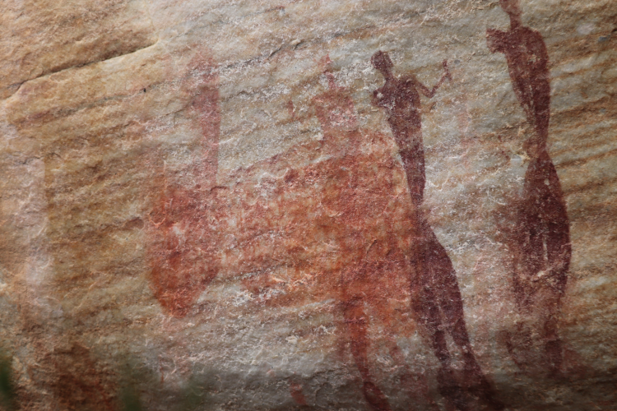 Figure 14: Shamanistic Dance & Floating Through the Air |
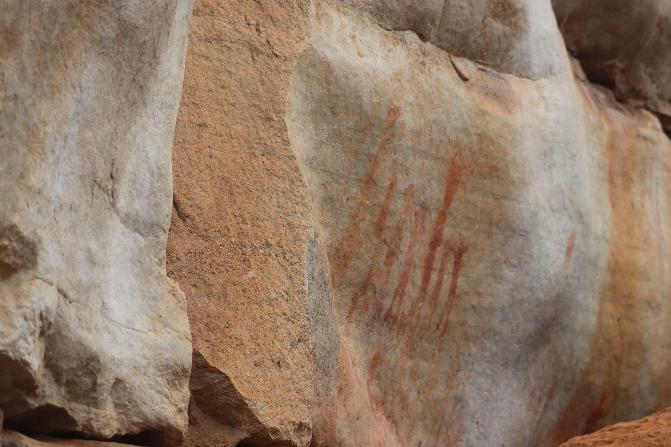
Figure 15: Shamanistic Dance
San historians tell us that if a San boy is selected to become a Shaman, he dances with the experienced Shaman until he learns to enter the trance state, where he, too, can have and interpret visions. The effects of trance – emotional reactions and physical and auditory hallucinations are often depicted. Noses bleed, contorted bodies need the support of walking sticks, dancers morph into people-animals or strange geometric shapes.
What one culture calls madness becomes a spiritual talent in another!
The eland always appears in the Great Dance, second only to Kaggen, the praying mantis! Kaggen is the primary creator, trickster, and shape-shifting deity in Cederberg San mythology.
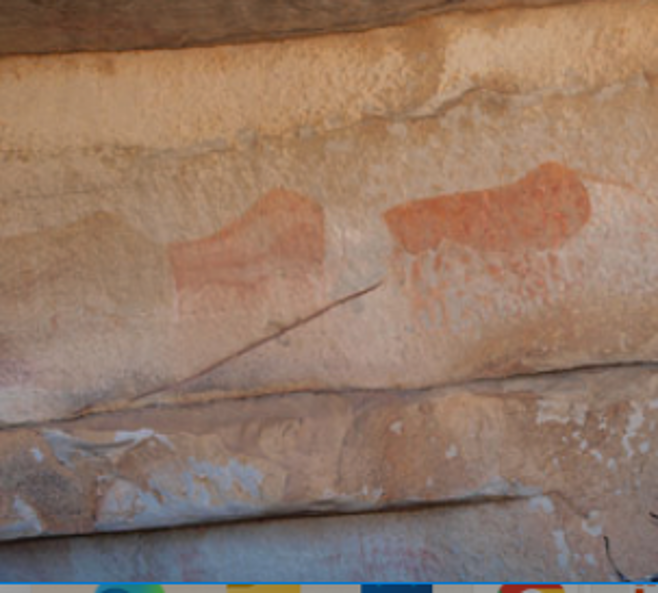 Figure 16: The Eland—Second only to Kaggen—the Mantis—With the White heads |
It’s a great pity that the Green family ancestors liked eland meat and biltong so much that they killed off most of the eland in the Cederberg (and other) areas the San hunted in.
Jim tells about the ostriches and Kaggen following a trip to Botswana, where they saw some ostriches. The Greens saw some ostriches on the horizon on their way to the Cederberg—too far to observe or photograph:
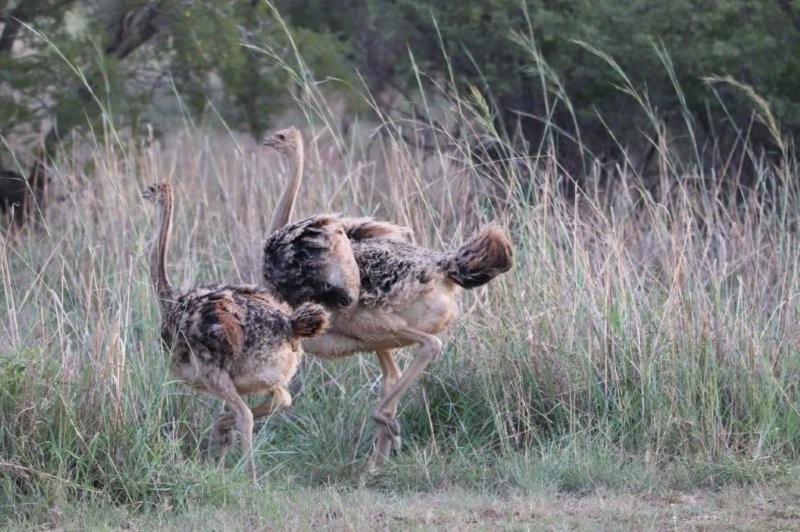 Figure 17: Ostriches in Botswana |
Such ostriches often appear in San rock art, but not Kaggen, as ‘he’ takes many forms as a trickster. Ostriches and their friend, the praying mantis, hold a special place in San mythology. Here is a San[17] story:
In San culture, the mantis is a trickster figure named Kaggen, who is a folk hero and demiurge (a being responsible for the creation of the universe). Kaggen can change shape and often appears as a praying mantis.
Kaggen had noticed that whenever Ostrich went to eat, his food smelled different and delicious. So one day, he crept close to Ostrich to observe him as he ate. He saw Ostrich furtively take some fire from beneath his wing and dip his food into it. When he had finished eating, he carefully tucked the fire back under his wing and walked off. Kaggen knew that Ostrich would not give him any fire, so he decided to make a plan.
One day he went to visit Ostrich. ‘Come,’ he called, ‘I have found a tree with delicious yellow plums on it.’ Ostrich was delighted. He began to eat the plums that were easiest to reach. ‘No, higher, higher! The best ones are right at the top,’ Kaggen urged him. As Ostrich stood up on tiptoe and spread his wings to balance himself, Kaggen snatched some of the fire from beneath his wing and ran off with it.
This was how he brought fire to the San.
Since then, Ostrich, terribly ashamed, has never flown and keeps his wings pressed to his sides, to preserve the little fire he has left. According to the San, the ostrich has always been rather an odd fellow. When the female makes her nest in a hollow in the warm sand, she lays 20 to 30 round, creamy eggs, but invariably leaves one outside. Why? Because she and her husband are so busy brooding on the theft of their fire, that they can be very absent-minded. She is even liable to forget she is sitting on a clutch of eggs, and so she puts one on the outside of the nest, just to remind herself and her husband, that they have eggs in the nest.
The Spiritual Animals
Anthropologists and Art Historians tell us the following:
The beautifully rendered elephants, rhinos, elands, and dancing humans could be 5,000—10,000 years old!
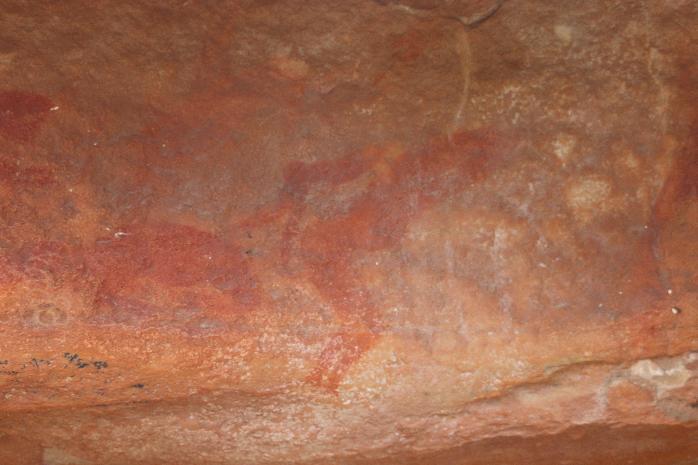 Figure 18: Rhino and Dancer. |
Animals with special supernatural powers are depicted in the shamanistic Great Dance. As a result, springboks, kudu, and buffalo are intentionally absent from the Cederberg rock galleries, while rhinos, elephants, and elands appear in countless images.
We saw that the eland, the largest antelope species, is the most frequently depicted animal in the Cederberg. The San artists lavished the most care upon them, showing them from various perspectives and in a variety of postures – sometimes even with human legs.
San artists believed they were able to coax the spirits of the other world to come through the rock, so by painting the neck and head of the eland in white, the artist may be suggesting that the image was entering the rock through the rock ‘veil’ separating his (possibly her as well) world and the realm of the spirits.
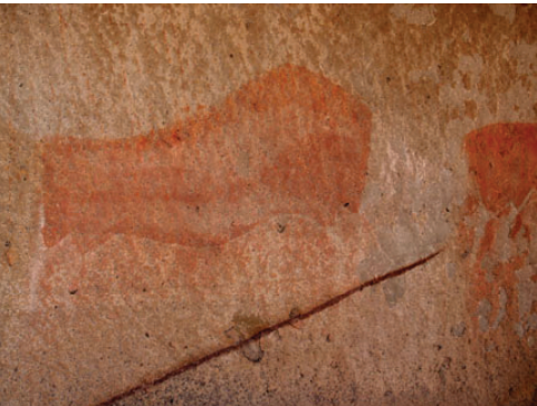 Figure 19: Eland Head in White |
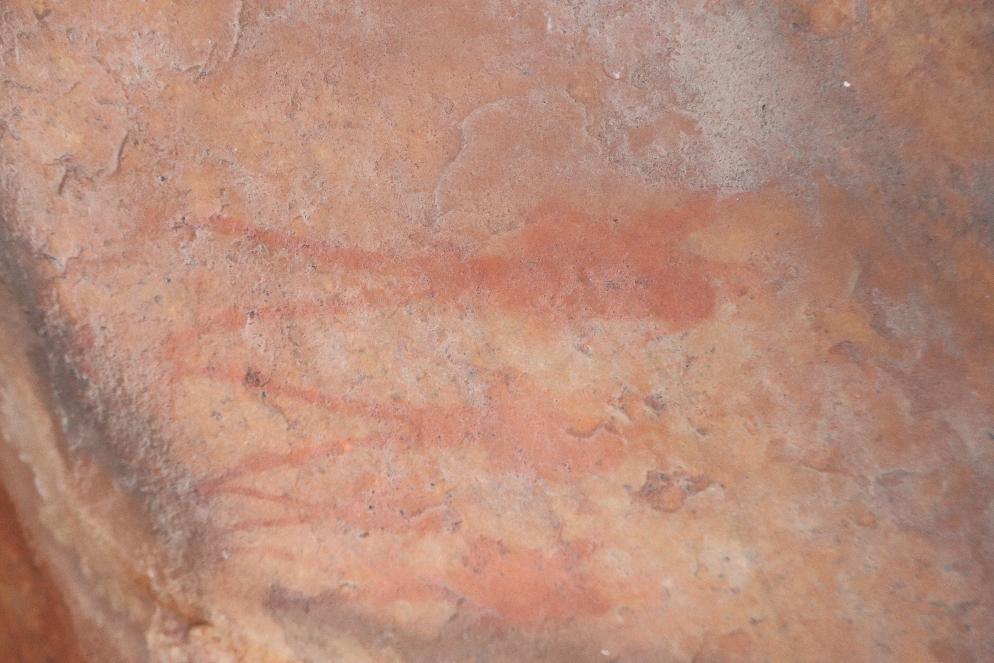 Animal & Human parts |
Was an eland skin wrapped around a hunter? We will never know if there was some symbolism in that!
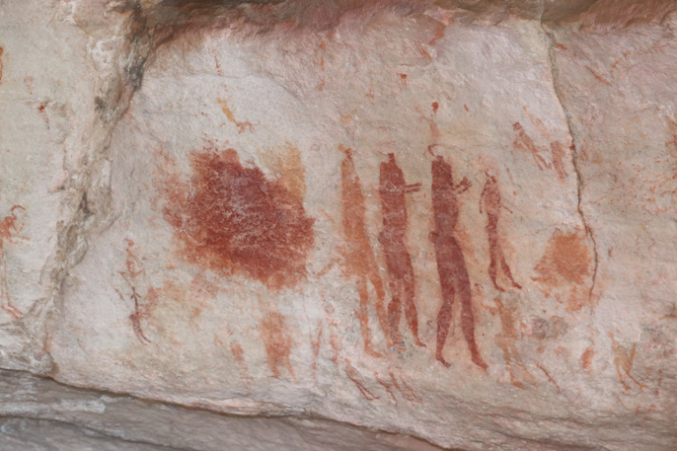 Figure 20: Eland Killing and Skin draped around a hunter. |
A San dance around an elephant in the Stadsaal Caves is shown [17]. The dancers are distinctly male as they float in the air. The graceful figures bend forward, hold dancing sticks, wear ankle rattles, and sometimes bleed from the nose.
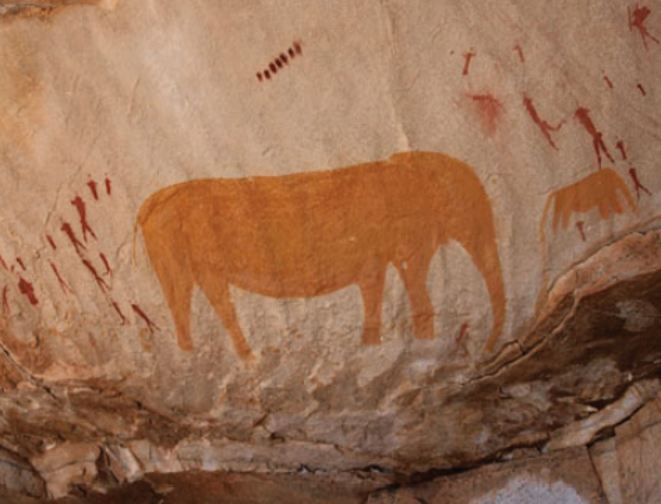 Figure 21: Elephants |