Images In Africa—Photo Ahimsa
Green Images
DEDICATION
This book is dedicated to all nature lovers who seek to be loved in turn by nature.
We hope that our photographic encounters and connections with the natural world will further inspire those who are fighting to prevent the loss of our shared home—our ecosystems.
PREFACE
Do not say that I’ll depart tomorrow
because even today, I still arrive.
Look at me: I arrive in every second
to be a bud on a spring branch,
to be a tiny bird whose wings are still fragile,
learning to sing in my new nest,
to be a caterpillar in the heart of a flower,
to be a jewel hiding itself in a stone
—Thich Nhat Hanh1, Engaged Buddhist
If you like nature (most of us do) and want to help save the planet, do an eco-tour in your garden, at a local green space, along a creek or river, or in a botanical garden—most towns and cities have those nowadays.
Otherwise, head to the hills or wetlands, if they haven’t been turned into something else. If the coast beckons, a tour along the beach, away from the sporty areas, can be a rich experience!
If you’re more adventurous and have the time, go on a self-managed eco-tour somewhere where habitats are still intact.
In this book, we share with you our experiences visiting African habitats. The alarming threat of ecocide (like genocide), driven by the destruction of natural ecosystems worldwide, has motivated us to share our experiences of eco-tourism—and to encourage a practice that we have called Photo Ahimsa—or simply, ‘shooting by camera’.
Don’t be alarmed; it is not a cult practice, just our fanciful name for an informal mindfulness practice that involves taking photographs of nature.
We found that capturing the beauty, art, and intelligence (and the suffering) through photography is more than an art—it can be a transformative mindfulness practice! With each click of the shutter, you’re drawn into the present moment, allowing yourself to connect deeply with the environment.
Photo Ahimsa is not about capturing a perfect shot to share online; it is about ‘hearing’ the stories told by our natural world. It also allows us to connect with things that you would usually walk right past—such as this butterfly settling on a park bench.
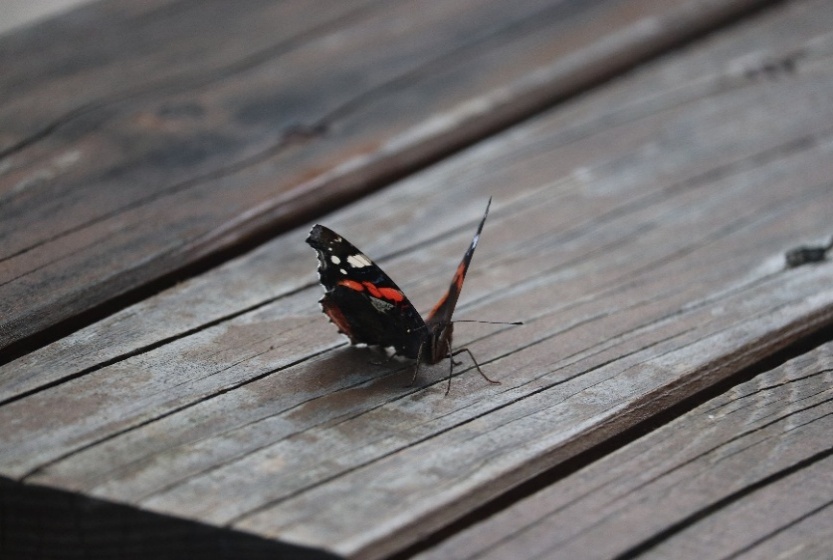
Easy to Miss.
Our senses are the first to connect with a subject—seeing form, geometry, colour, and hidden details; then the lens brings it all together.
The mind is captured in the ‘here and now’.
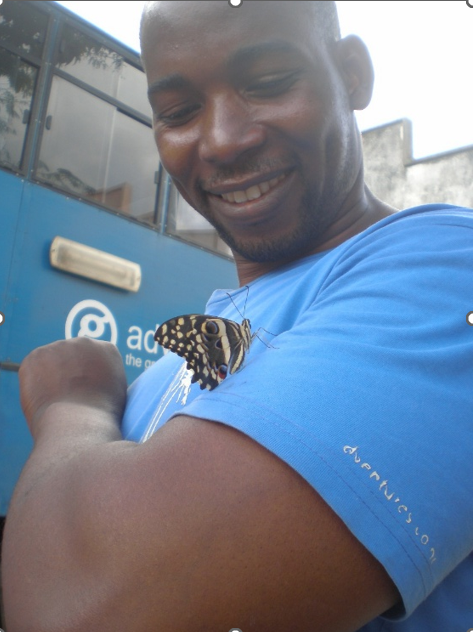
‘Here and Now’—Butterfly at Masai Mara.
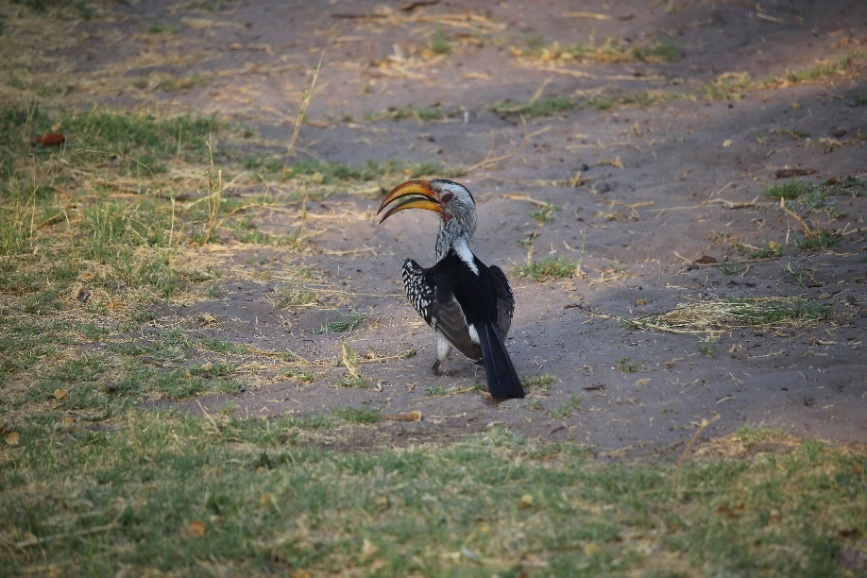
‘Here and Now’—Form and Intelligence, Kwai River.
Focusing on settings, framing, and a scene in nature allows time to seem to stand still and worry and anxiety to take a back seat.
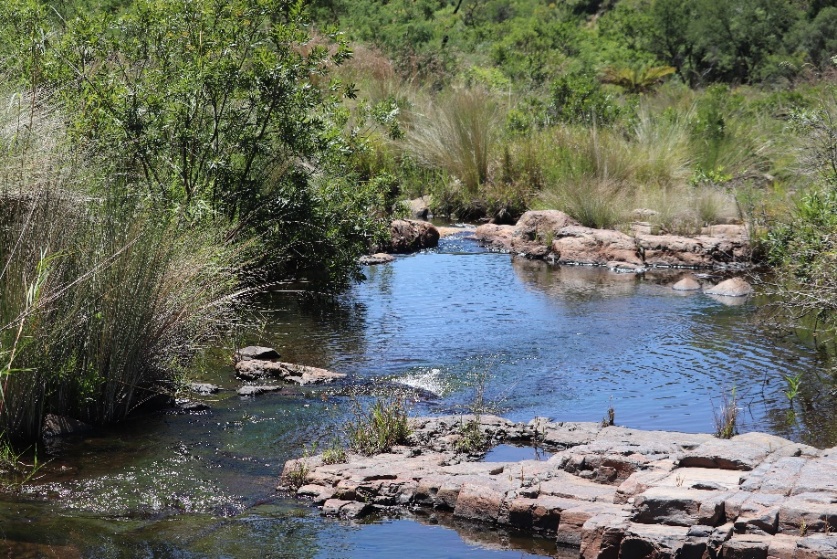
‘Here and Now’—Dome Pools Magaliesberg.
Practising Photo Ahimsa also requires skills that most people possess. The stalking skills we learned in childhood, such as those used in ‘hide and seek,’ are essential!
A bird will fly, or the animal disappears into the undergrowth, often long before they’re seen, if you’re not careful. Nature will only reveal itself to you if you do the right thing.
If you’re thinking about an email you should have sent or the conflict in the Middle East, you’re bound to lose focus or lose your footing. In an instant, your subject has vanished, and you have no photograph.
It is not possible to come across a little Malachite kingfisher in the reeds, let alone get into position to photograph it, if you’re thinking of something else.
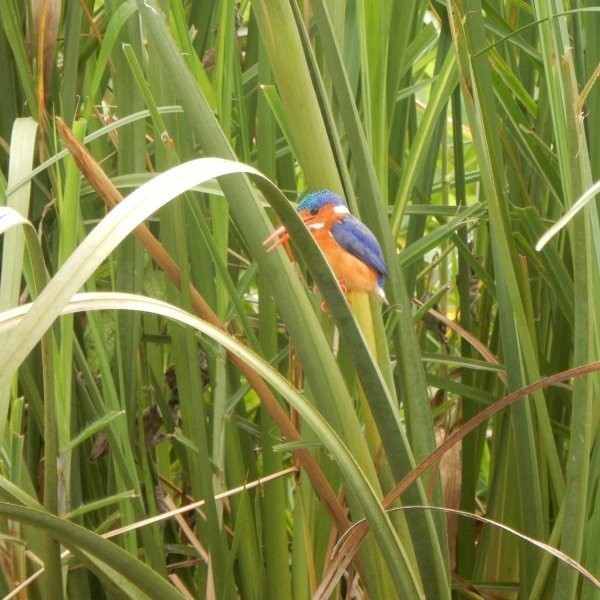
‘Here and Now’—Malachite Kingfisher, Uganda.
The practice of Photo Ahimsa, or any nature photography, has been shown by mental health practitioners to improve mental health. It is better than using antidepressants, benzodiazepines or buspirone.
Apart from the health benefits, the photographs tell their own stories—birds, animals, insects, flowers, and trees— telling us about their living spaces—places where they interact with one another and with the inanimate environment.
Nature unselfishly shares its poignant intelligence, beauty, and artistry with us. Science affirms that birds and other animals (we all belong to Animalia) experience positive emotions such as joy and happiness, as well as negative emotions such as fear and anger, just as humans do. They share similar brain structures and receptors (e.g., dopamine receptors) with ours.
This book, edited by Jim Green, is a collaborative effort that captures the eco-tour experiences of our Green family members. Jim (husband), Dedrie (wife), Peter (son), Hilda (daughter) and Ella (granddaughter).
Foreign language words, personal stories, and fictitious wildlife stories are written in italics.
Practice Photo Ahimsa—become fearless eco warriors!
AN EPIPHANY
All beings tremble before violence: all fear death, all love life. See yourself in others. Then whom can you hurt? What harm can you do?
—Siddhartha Gautama, The Buddha
The Sugarbird
Boys in Africa hunted in their childhood and teenage years, shooting birds and collecting their wings as trophies. Bedroom walls were festooned with colourful, patterned wings of many birds that met their premature ends from air-rifle pellets.
There was competition among the boys as to who had the most exotic wings on their bedroom walls. Most boys in colonial Africa in the 1950s and 1960s read books about hunting and played games about shooting animals such as elephants, lions, and gorillas.
Like St. Paul on the Damascus Road, Jim had an epiphany early on. He started to shoot with a camera, capturing images of wildlife instead, and then left creatures that fly, creep, crawl, walk, and run to continue sharing their lives with others.
What was behind the epiphany?
For most hunters, it was impossible to miss the antics and interesting behaviours of birds and animals, as well as their beautiful colouring, forms, patterned feathers and hides. Nor would one miss the beauty of the veld—the flowers, grasses, shrubs and trees.
He tells these stories with much regret:
In the 1950s, we lived in the mining town of Musina, on the banks of the Limpopo River. There, in the pristine veld, I hunted birds, collecting their wings as trophies—an activity most boys indulged in. It was a status symbol to possess a good air rifle, or better still, a 0.22 rifle.
There would be shouts of triumph when the thud of the pellet from my air rifle signalled a hit, and the doomed bird fell like a stone or fluttered its way to the ground. If injured, I would wring its neck.
The experience was always unsettling! I felt a sense of loathing whenever I had a ‘success’—sometimes bringing tears when I picked up the injured, shivering little body.
One day, an incident occurred that would change me forever. A beautiful sugarbird was busy, fluttering around a protea in a flower bed in our front garden, sucking nectar while its little wings kept it buoyant. I ran inside to collect my air rifle, intent on securing that bird’s wing!
As the sugarbird settled on a flower, I drew a bead on the little speckled breast. The pellet found its mark, and the sugarbird dropped to the ground, stone dead.
I ran into the house, gleefully holding my prize high. But I did not reckon on my sister Joan’s reaction. She took one look at the tiny, feathered figure I held in my bloodied hand and let out a piercing scream, “Dad, come quick; Jimmy has killed our little sugarbird!”
My dad believed in “spare the rod and spoil the child”; I was not spared, but I spent that night crying over what I had done. Then, I did not realise it, that little sugarbird would haunt me to this day.
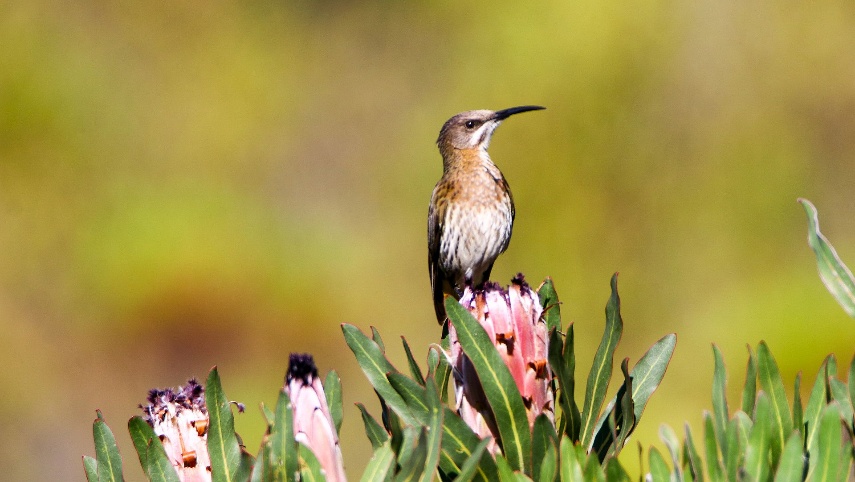
The Sugarbird.
That same year, my dad went with a hunting party to bag a kudu or an impala. They set off, a veritable army of hunters, brandishing their Lee Metford .303 rifles. They returned laughing and joking, followed by a small truck carrying a very large kudu. They unceremoniously dragged it off and dumped it on the ground.
I walked up to the magnificent creature, lying on the ground, about to be cut up, felt the curvature of its beautiful, spiralled horns, and gazed into the lifeless, round eyes. I thought the eyes were terribly sorrowful. I wept for that kudu while the men laughed at me. My mother wept with me as she wiped my tears away.
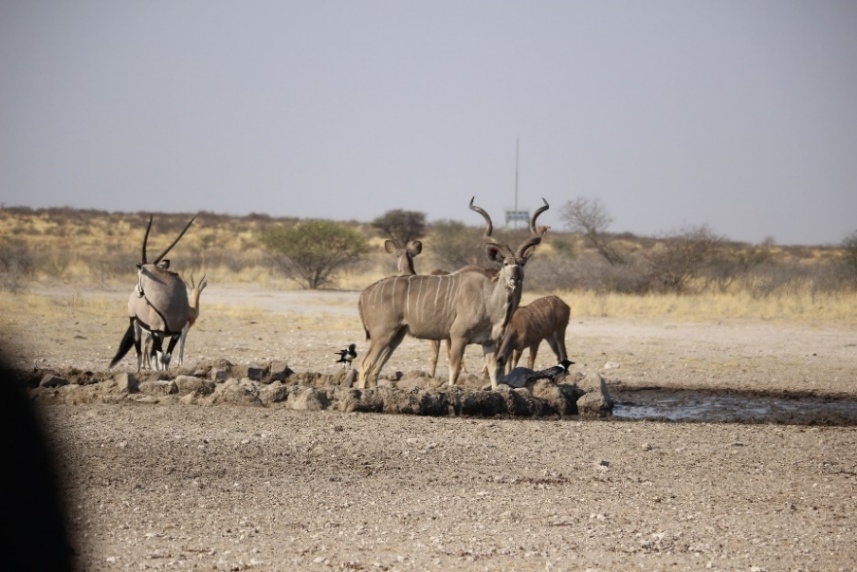
A Kudu and Friends.
A few years later, we moved to Nababeep in the Cape Province. A friend invited me to go hunting in the Richtersveld, a remote area near the Orange River.
My friend’s father was the proud owner of a Winchester .273 rifle—a powerful ‘beast’ of a rifle. We were to assist him, an expert night hunter who relied on a powerful torch and the rifle’s telescopic lenses to shoot anything that moved in the darkness.
I borrowed a .22 rifle from our next-door neighbour to assist him in his endeavours. He warned me, ‘There are three things one does not lend out: your wife, horse and rifle—look after the rifle with your life’—and that I did.
One night, we walked along tracks through the rugged Richtersveld terrain. We made our way over hilly, rocky ground, our eyes searching the rocks and boulders in the beam of the searchlight and under the kokerbome (quiver trees) for wily little klipspringers or any other nocturnal creatures.
The penetrating beam of the hunting torch swept across the rocky ground. Our eyes followed the circle of light as it illuminated all in its path, looking for pinpoint reflections that would give.
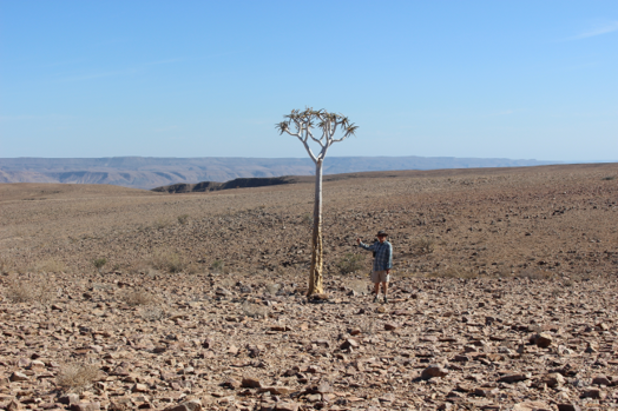
Kokerboom—Richtersveld.
We spotted a pair of eyes on a rocky ridge. The crack of the Winchester deafened me—the eyes disappeared immediately. The shout came, ‘Go and get him, Jimmy!’ I scuttled off, shining my torch—trying to find the gaps between boulders and through the sparse vegetation.
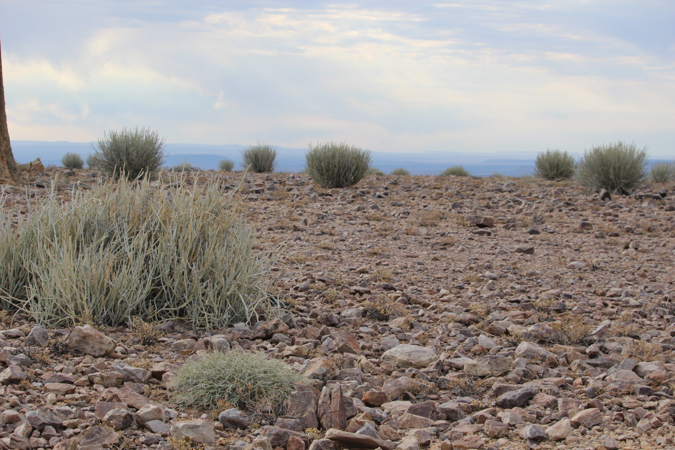
Rugged Richtersveld Terrain.
Up and up, I clambered, slithered and slipped until I stood on something soft. It was the tiniest of klipspringers. She was still warm, but all her life had poured out of the gaping hole in her side. ‘I have her!’ I shouted tremulously; I was devastated and sad. I wiped my tears as I clambered down. It was then that I decided I would never go on a hunt again.
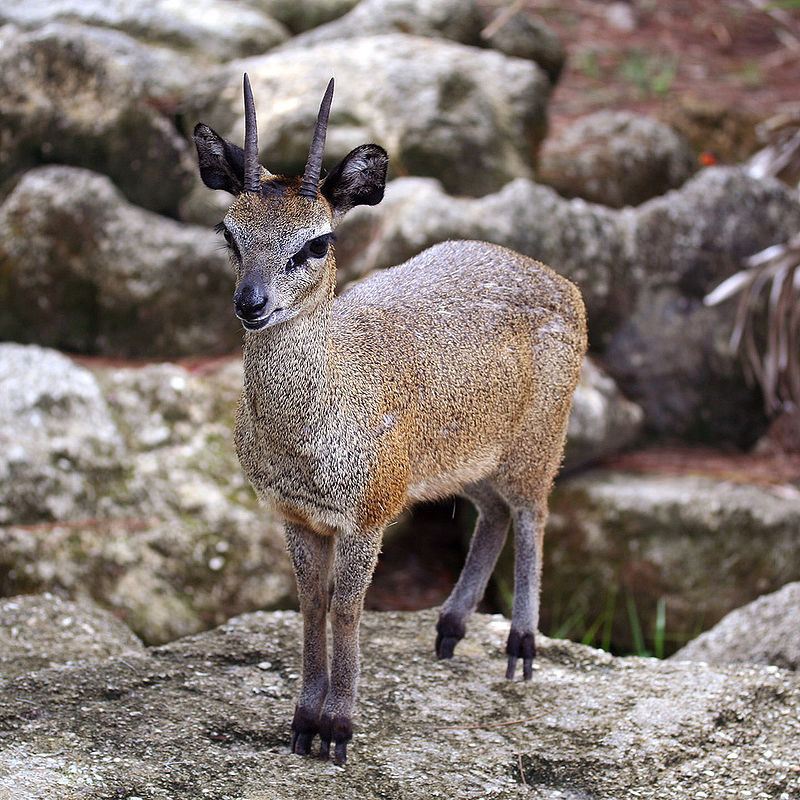
Klipspringer.
Jim laid down his rifle after shooting a Guinea fowl for dinner in the Eastern Transvaal (Mpumalanga). Peter and Hilda were with him when he shot the poor bird, warily peering at him from some distance away.
They tearfully asked, when seeing the lifeless, bloodied bird in his hand, ‘How could you eat such a lovely bird, so inquisitive and smart?’ He vowed never to hunt again— ‘I will shoot with a camera from now on,’ he said.
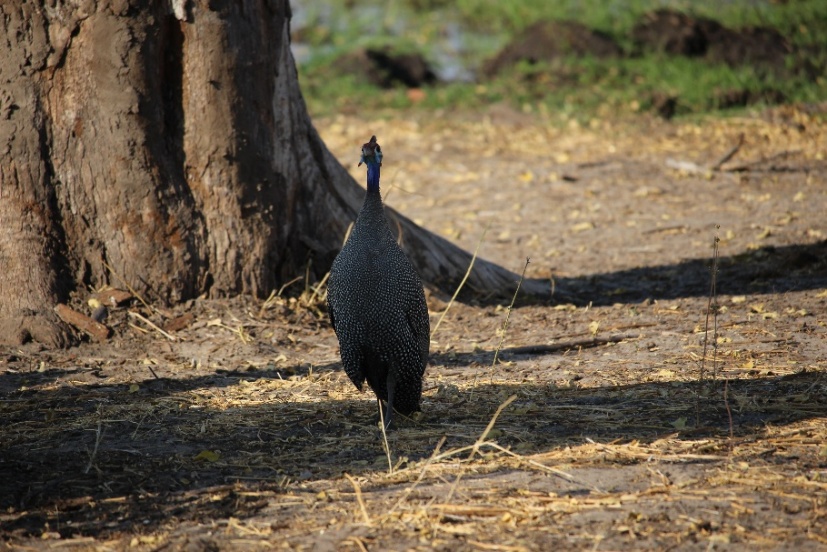
A Wary Guinea Fowl.
The Baboons
These animals are very close to us.
Musina (Limpopo) in the 1950s was an exciting and interesting place. We (a local gang of ten-year-olds) often met up with baboons in the veld (Error! Reference source not found. below)—all occupants feasting on marulas [a fruit loved by all—often ferments on the ground—reason for a universal
We would occupy the lower branches, taking care that an alpha male baboon did not show threatening signs. We were friends, kept our distance and enjoyed the feast together.
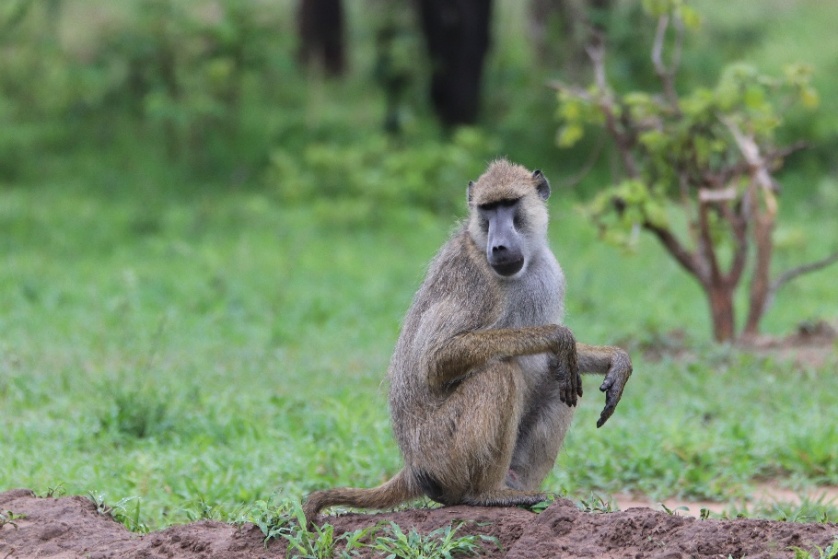
Pesky Baboon in Mkumi—Tanzania.
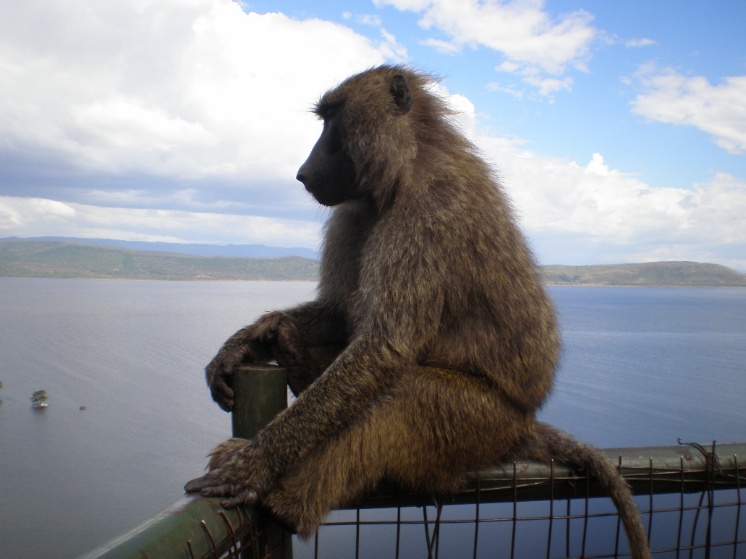
Baboon in Kenya.
But farmers kept baboons as watchdogs, tied up on a chain—an exceptionally cruel practice. With great shame, I confess that we used to tease the hapless baboons—make them attack us as we stood just beyond their reach. But I did feel pity for them and wanted the impossible—to quieten and console them!
I was an avid reader by the time I was ten years old. My favourite book was ‘Jock of the Bushveld (Error! Reference source not found. below)’. One of the incidents in the book was when the baboon, tied to a pole, was taunted and killed by the dog, ‘Jock’. That story—the baboon (Error! Reference source not found. below), tied up, teased and forced to fight, watched by the transport drivers haunted me for many years.
Here is what happened to the baboon:
It was not justice to call Jock off, but I did it. The cruel brute deserved killing, but the human look and cries and behaviour of the baboon were too sickening, and Seedling went into his hut without even a look at his stricken champion.
Jock stood off, with his mouth open from ear to ear and his red tongue dangling, blood-stained and panting, but with eager feet ever on the move, shifting from spot to spot, ears going back and forward, and eyes—now on the baboon and now on me—pleading for the sign to go in again. Before evening, the baboon was dead.
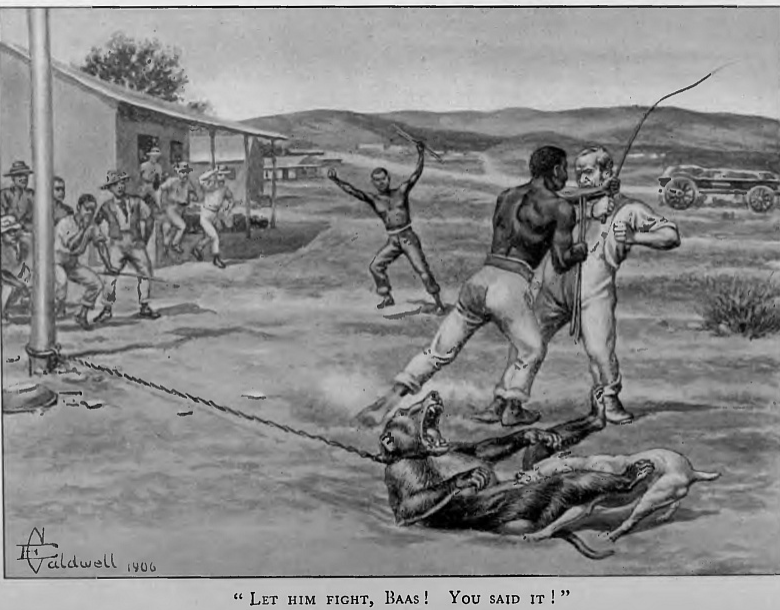
‘Jock of the Bushveld’ and the Baboon.
- Wikipedia contributors. (2025, May 26). Thích Naht Nanh. Wikipedia. ↩︎
panalokoapp
That Kentucky Derby analysis was spot on! Seeing trends before the race is key. Speaking of quick access, I’ve heard good things about the panaloko app download apk for mobile gaming – convenient if you’re tracking bets on the go! Solid post overall.
jilibibi
I’m exploring new tools for my freelance design work, and this platform bridges heritage gaming with modern tech beautifully. The seamless access via jilibibi makes it a standout choice for authentic digital entertainment experiences today.
PornPics
Here you are
hltv
Honestly, the depth in this analysis is surprising. I was wary, but the financial angle really grounded the hype. For anyone needing reliable access, check out hltv download. Caution is key, though!
jilittt
Man, this analysis nails the reads. Remember, poker is about reading tells, not just the cards. Check out jilittt slot for some different action when you need a break!
Nova1833
https://shorturl.fm/YH1mR
Jordyn230
https://shorturl.fm/Qsy2R
Mary114
https://shorturl.fm/TTYZp
Raymond4345
https://shorturl.fm/rt0yV
Eloise4929
https://shorturl.fm/3yoyL
Eloise3301
https://shorturl.fm/gTZRs
Kira2031
https://shorturl.fm/nNJQS
Carly1705
https://shorturl.fm/lLano
Anastasia4586
https://shorturl.fm/Vpznl
Emmett2329
https://shorturl.fm/FIRCz
Michael3870
https://shorturl.fm/U49Hy
Marvin2838
https://shorturl.fm/pBBeJ
Marley385
https://shorturl.fm/kRnWN
Cassandra2849
https://shorturl.fm/0WGcO
Omar3707
https://shorturl.fm/bIq6t
Britney4103
https://shorturl.fm/xq9Dp
Manuel496
https://shorturl.fm/Bjf2x
Francis1061
https://shorturl.fm/w5Wre
Donald882
https://shorturl.fm/57JR6
Maggie2464
https://shorturl.fm/XHd6K
Makenzie133
https://shorturl.fm/IYPmB
Juliana2711
https://shorturl.fm/OC2ET
Adalyn4007
https://shorturl.fm/LAQSJ
Debbie2517
https://shorturl.fm/FgwOm
Marco2045
https://shorturl.fm/OGFzw
Darren3772
https://shorturl.fm/RjRb7
Bonnie1176
https://shorturl.fm/0VIgl
Olivia3860
https://shorturl.fm/xLHQV
Lilly3630
https://shorturl.fm/ljeD9
qrkvpirrmx
wljhwetwqrznlkgjmoyfyvlotnejrs
Hendrix291
https://shorturl.fm/MFIC5
Sophia3724
https://shorturl.fm/c3ekE
Angela3054
https://shorturl.fm/jskBc
Elizabeth1939
https://shorturl.fm/MQgNN
Kenny3180
https://shorturl.fm/ZNJ2N
Gerald4533
https://shorturl.fm/ge5aY
Eric777
https://shorturl.fm/HVKbN
Conrad3792
https://shorturl.fm/gwDdO
April4596
https://shorturl.fm/uzWUO
Josh2664
https://shorturl.fm/qjqty
Evan3261
https://shorturl.fm/Cls9d
Brian249
https://shorturl.fm/FRqCJ
Jamie3134
https://shorturl.fm/iPqOf
Bob1773
https://shorturl.fm/4WQEk
Jeff3264
https://shorturl.fm/lJvlR
Lynda4454
https://shorturl.fm/gTyel
Teresa2655
https://shorturl.fm/stE6a
Pat4389
https://shorturl.fm/TU5yK
Simon4613
https://shorturl.fm/UnFsb
Steve1968
https://shorturl.fm/ht52R
Darryl4754
https://shorturl.fm/vUhl3
Lawrence3500
https://shorturl.fm/pE0yi
Kristina3176
https://shorturl.fm/04dC0
Austin1634
https://shorturl.fm/Pduho
Beckett109
https://shorturl.fm/arbhO
Pearl221
https://shorturl.fm/uiNNV
Regina3170
https://shorturl.fm/ictNb
Levi3340
https://shorturl.fm/VcS3p
Adria4328
https://shorturl.fm/9n2co
Rhys465
https://shorturl.fm/YgENd
King402
https://shorturl.fm/wVoGH
Easton3509
https://shorturl.fm/HsgzC